
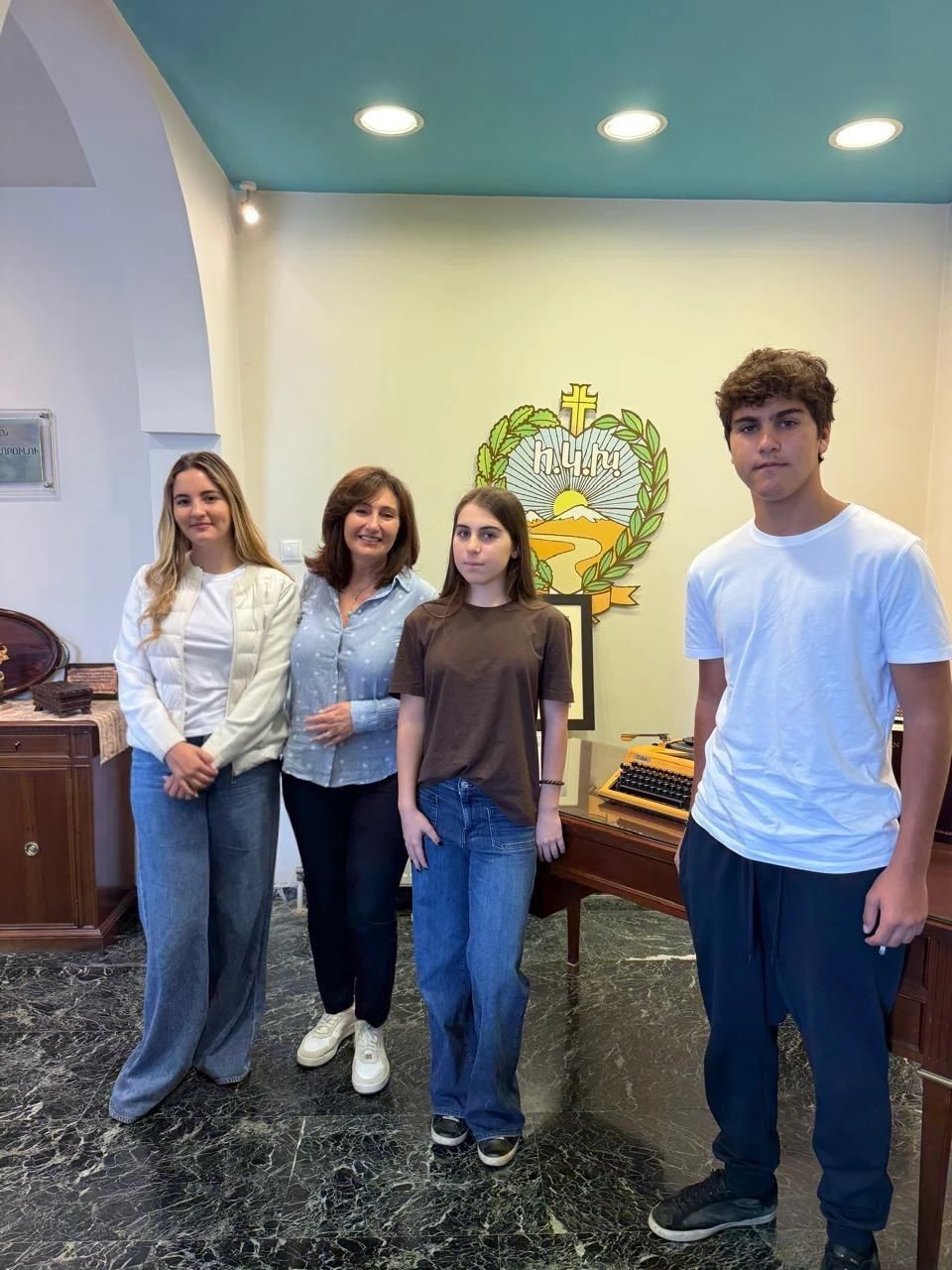
Mrs. Nora Kurdoglian Interview
Published on Sep, 2025
We had the honor of interviewing Mrs. Nora Kurdoglian, Vice President of the Armenian Blue Cross of Greece. In our conversation, she shared the rich history of the organization, its nearly 100 years commitment to supporting the Armenian community, and the vital role of volunteerism in preserving Armenian culture and language.
Her final message to us, as 15 and 17-year-olds growing up between two cultures, Greek and Armenian, was especially inspiring:
“You are very lucky to be growing up between two ancient and unique cultures! It is truly a treasure for the soul and spirit to absorb the ideas, values, artistry, and beauty that each culture has to offer. The Greek and Armenian cultures share many points of connection. Get to know both deeply, and then learn to love both, because they have contributed great ideas, arts, literature, and music to humanity. When you feel them as one within yourself, yet also as two distinct and separate entities, I believe you will be proud of your heritage — and ready to give your very best to the world.”
1. Could you tell us a few words about how the Armenian Blue Cross began and what its first steps were?
The Armenian Blue Cross was founded in Greece in 1924, with the purpose of supporting the Armenian refugees who arrived after the Asia Minor Catastrophe of 1922. As is well known, among the 1,020,000 Greeks who sought refuge in Greece after the destruction of Smyrna, there were about 100,000 Armenians who had lost their homes and had lived through the horror of the Turkish atrocities.
In those first years, the needs were immense. One of the first and most important initiatives of the Armenian Blue Cross was the establishment of a small clinic, where volunteer Armenian doctors and specialists provided medical assistance. However, what I believe was the most significant decision made by the organization was the creation of schools — places where Armenian children could learn their mother tongue and, most importantly, their history. In this way, they could feel proud of their national identity, despite all that their families had endured.
It was an incredibly difficult undertaking, made possible thanks to the dedication of the entire Armenian community at the time and the support of Armenians from the wider Diaspora. Our schools — two kindergartens, two elementary schools, and one high school of the Armenian Blue Cross — continue to operate to this day. We are deeply proud of them and of all the students who have attended them!
For a century now, the Armenian Blue Cross has served faithfully, with the purpose of philanthropy and the preservation of Armenian consciousness through generations.
We also promote volunteerism, as our organization is based solely on the voluntary work of its members.
Our actions aim to promote social welfare, as well as the social and spiritual development of the Armenian community in Greece, as well as the people of Armenia and Artsakh.
It is important to mention that throughout the years, the Armenian Blue Cross has enjoyed the full trust of our compatriots — and also of our Greek friends — because it operates with complete transparency and the selfless contribution of its members. That, nowadays, is rare.
Finally, it is worth noting that our association is a member of the wider pan-Armenian philanthropic organization, the Armenian Relief Society (Հայ Օգնութեան Միութիւն - H.O.M.), which is active in 27 countries across the world, wherever there is an organized Armenian diaspora.
2. The Armenian Blue Cross has been active for almost a century. What do you believe keeps it alive to this day?
First of all, the greatest moral satisfaction that comes from helping others!
The truth is, we are a people who have suffered greatly, and history has often placed many hardships in our path. That means there are always countless ways in which we can — and must — support those among us who are struggling.
At the same time, as the years go by, it becomes increasingly difficult for younger generations in the Diaspora to preserve our language and culture. So the need to always be present — wherever help is needed — and the timelessness of our mission are what keep the Armenian Blue Cross alive.
However, I would also like to say that beyond being alive, the organization remains actively present. And this, I must acknowledge, is thanks to its members — to the respect they have for one another, to the empathy we share, and to the friendships that grow through our work together.
What led you to get involved with the Armenian Relief Society (Armenian Blue Cross of Greece)?
To be honest, I first got involved because I was too embarrassed to say no! Many years ago, the Board of Directors at the time asked me to join the editorial team of a women’s monthly insert that the Armenian Blue Cross of Greece published within the Armenian newspaper Azat Or. That’s how it all began.
However, through learning more about the organization’s work and activities, and through what I had to write for the publication, I realized something very important — that philanthropy, in its essence, is a deeply political act. And I don’t mean “political” in the sense we usually give the word today, but in the Aristotelian sense — that of a “political being,” a person who acts for the good of the community.
What truly kept me involved, though, as I mentioned earlier, were the relationships that develop among the members — and the feeling that you belong to a large family. It’s a family you simply cannot disappoint.
4. Who or what has been the greatest inspiration or influence in your life to follow this path?
The greatest influence has been my mother. She deeply believes in the mission of this organization and has always been one of its most loyal and active members — even today. In fact, I first became involved because she constantly encouraged me to do so.
Another source of great inspiration is a remarkable chapter in our history — the vast humanitarian effort to rescue and care for Armenian children after the tragic years of the Genocide. Under the slogan “One gold coin for one soul,” thousands of Armenian children were found and saved through the tireless efforts of volunteers.
I am also inspired by great figures — people with a capital “P” — such as our celebrated writer and poet Hovhannes Tumanyan, who, after 1916, was always present wherever refugees needed help, and later dedicated himself entirely to organizing relief and caring for thousands of orphans who had lost everything.
5. What do you consider to be the most important activities that the Armenian Relief Society (Armenian Blue Cross of Greece) has carried out in Greece?
As I mentioned earlier, I believe that the establishment and continuous operation of the Armenian schools is the organization’s most important achievement in Greece.
As for our activities, there have been many and of various kinds over the years. Among the most significant, I would say, are:
- Providing financial support to Armenian clubs where various associations are active, and where young people and children gather for social, athletic, and cultural activities.
- Organizing blood donation drives and maintaining a Blood Bank, through which hundreds of our compatriots have been helped.
- Offering financial assistance to Armenian individuals and families in need — especially those facing serious health or economic difficulties.
- Providing food and basic goods to Greek families in need, in cooperation with the charitable organization Apostoli of the Church of Greece (on the occasion of the 100th anniversary of the Armenian Genocide).
- Gathering and sending humanitarian aid to Artsakh during the 2020 war, amid the COVID-19 pandemic.
- Offering aid to the earthquake victims in Armenia in 1988.
- Participating in the A.R.S. program “Embracing an Orphan” from Artsakh.
6. Is there a particular moment or experience from your work with the Armenian Relief Society that has stayed with you as unforgettable?
I will never forget the days when we were organizing and collecting humanitarian aid for Artsakh in 2020. They were tragic days — the war was raging in Artsakh, threatening Armenia, and the atmosphere was filled with sadness and anxiety, while at the same time we were all dealing with the stress of COVID.
It was a huge task, but we all felt strong and united. We overcame many difficulties to make sure everything was organized properly.
It was deeply moving to receive hundreds of messages of support — not only in words but in actions. What touched me the most, though, was seeing our young people come to volunteer, dedicating hours of their time to help us. I remember that there was a curfew at the time — we had to send a code message to the “Civil Protection” service each time we went out to collect donations, record them on lists, sort and pack everything carefully.
The Board of Directors was in constant “telephone session.” It truly felt like we were taking care of a second family within the Armenian Relief Society.
Every day we received heartbreaking news about hundreds of victims and wounded… We felt that material aid alone was not enough. So, in every box we packed, we placed a small handwritten message of love and solidarity for the person who would open it. And there were hundreds of boxes.
It’s hard to describe in words what we felt during that time — even now, as I speak about it, I get emotional.
7. How important is the role of women in the Armenian Relief Society (Armenian Blue Cross of Greece), given that it was founded by women?
It was indeed founded by women — and even today, the majority of our members are women, although the organization’s bylaws place no such restriction. Perhaps it’s that unique female strength — the sensitivity women bring to issues of charity and the upbringing of children, combined with an ability to organize effectively.
How important were schools, churches, and orphanages in helping Armenians preserve their identity?
Mainly through schools, they preserved their language and identity. Most of Greek Armenians are bilingual. Memory of the Armenian genocide is also preserved in school education as well as in families.
The truth is that, on one hand, the Armenian Relief Society gave Armenian women a voice, a means, and opportunities to participate actively in community affairs. On the other hand, Armenian women have given the organization its character, its soul, and a century of life and achievement.
8. How does the Armenian Relief Society collaborate with other organizations in Greece or abroad?
First of all, we work closely with other Armenian Relief Society chapters around the world — both in the Diaspora and in Armenia — to carry out large-scale programs such as the Mother and Child Health Center, the Orphans of Artsakh, and the Shelter of Hope for refugees.
At various times, we have also cooperated with Caritas Hellas, the Hellenic Red Cross, and the Apostoli organization of the Church of Greece to provide assistance to war refugees or families in need here in Greece.
The international leadership of the A.R.S. also collaborates with World Vision and other organizations that participate in the ECOSOC of the United Nations.
9. What do you consider the biggest challenges the Armenian Relief Society (Armenian Blue Cross of Greece) faces today?
The greatest challenge today is encouraging the younger members to participate more actively. This is becoming increasingly difficult, considering how many responsibilities working young women have nowadays and how demanding volunteer work at the A.R.S. can be.
Another challenge in our time is convincing young Armenian women and men to join the organization and to realize that the mission and work of the Armenian Relief Society are timeless and not limited by age.
10. How can young people like us help or participate in the activities of the Armenian Relief Society?
It’s simple. Respond to the calls and invitations of the organization, knowing that every contribution — whether it’s your time, money, knowledge, or even just your presence — always goes to a good cause.
It would also be wonderful if young people shared their ideas about the future of the Armenian Relief Society — how they envision it in the years to come, and any suggestions they might have.
11. How important is it for a young person to know the Armenian language, culture, and traditions?
It’s like asking how important it is for someone to know themselves.
Ideally, every young Armenian should make an effort to learn the Armenian language and connect with the culture and traditions. This is first and foremost important for their own personal growth, identity, and sense of self. And naturally, having conscious, aware young people is also the strength of our people as a whole.
12. If we asked you to give a message to us, 15-and 17-year-olds growing up between two cultures (Greek and Armenian), what would it be?
You are very lucky to be growing up between two ancient and unique cultures! It is truly a treasure for the soul and spirit to absorb the ideas, values, artistry, and beauty that each culture has to offer. The Greek and Armenian cultures share many points of connection.
Get to know both deeply, and then learn to love both, because they have contributed great ideas, arts, literature, and music to humanity. When you feel them as one within yourself, yet also as two distinct and separate entities, I believe you will be proud of your heritage — and ready to give your very best to the world.